At Sol 2012, we asked ourselves what a Religious Method, equivalent to the Scientific Method, would look like.
Science, in the sense of testing ideas by experiment, was done for thousands of years before it got its scientific method. But most of humanity's progress in science has been achieved in the 400 years or so since it got its method. Perhaps religion could begin a period of rapid progress if it had a method of its own.
Questions that would be answered by a Religious Method
- What does religion do? What must a religion have to be a religion?
- What do religions not do? What should religions be forbidden from doing by the method?
- What is a religious question? What kind of questions do religions ask and what do their answers look like?
- What steps are there to answering religious questions?
First Draft
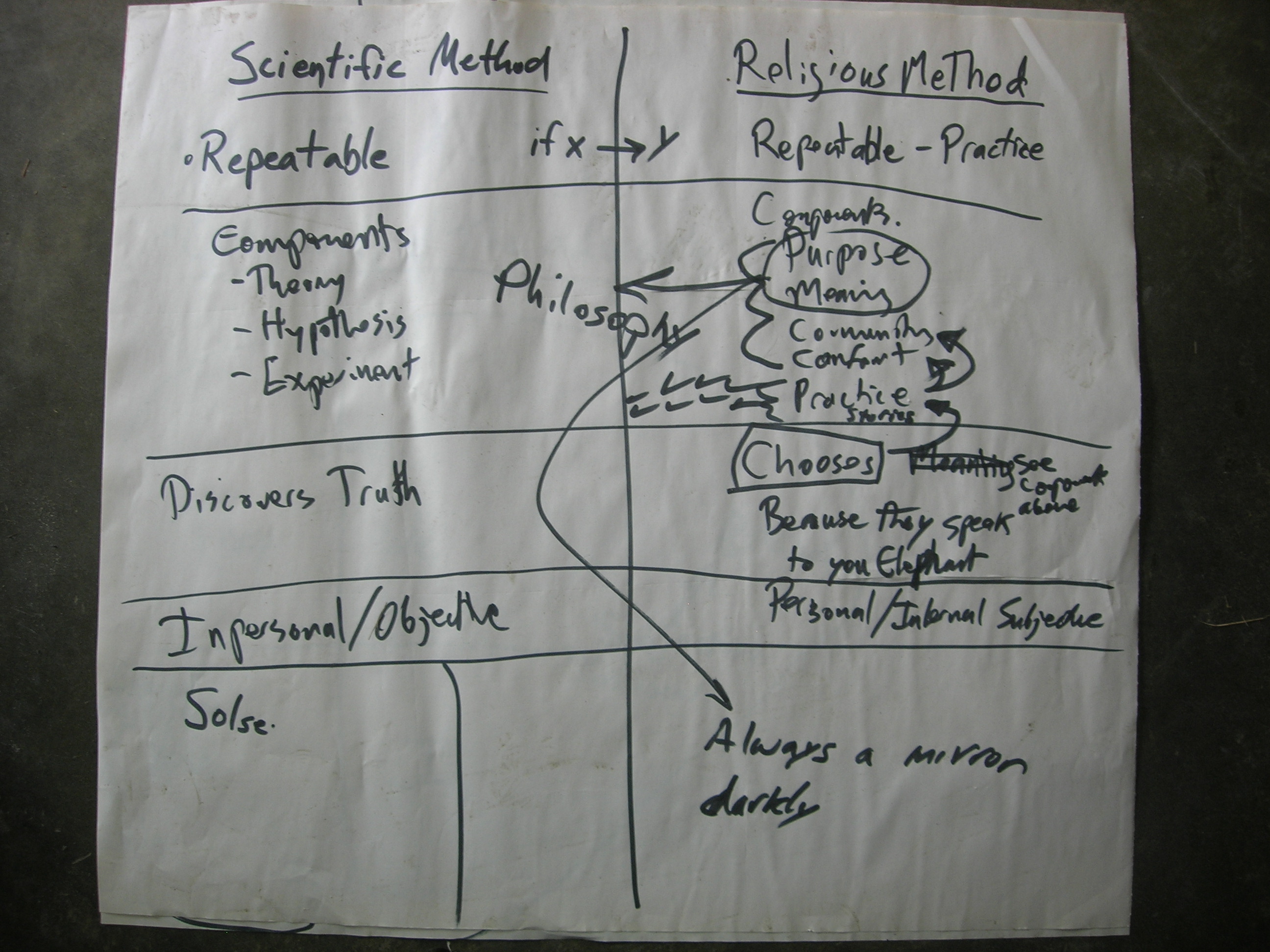 This was presented by Eric and Brandon on the second day of Sol 2012.
- Originally we said science is about discovery and religion is about choice; we then decided that the Religious Method is about both discovery and choice.
- Components needed for a complete religion:
- Practice and stories (Brandon thought this was the most important)
- Community and comfort
- Purpose and meaning (Eric thought this was key)
- This is discovered inductively through experience, not chosen.
- [Added 2012/07/09] Eric is reconsidering this. Behind this concept was a whole discussion on whether there is a universal purpose and meaning to life or whether there are only general purposes and meanings. I am starting to think that neither of these questions matters. Either there is a universal meaning and purpose to life but because it is always seen through a mirror darkly we can never be certain we have discovered what it is, or we are chosing meanings and purposes for our lives and trying to discover by trial and error a meaning and purpose that speaks to us as individuals. Either way, it is a process that involves experiment and as with science, the process requires freedom in order to achieve results. The difference between a scientific experiment and a religious experiment is related to the dichotomy between objective and subjective. Scientific method, to be properly implemented, requires scientists to maximize their objectiveness. Religious method, because religion explores subjective questions, can not require objectiveness. Each individual becomes the sole judge of whether or not a religious idea speaks to them.
- Therefore it's always provisional and "seen through a mirror darkly." Certainty is illusory.
- Recognizing this means religions have to tolerate other religions. From another frame of reference, your purpose and meaning could be obviously wrong.
Discussion
- Ben: Traditional religions' adherents will equate this attitude to moral relativism
- Brandon: Is tolerance a fruit of religion?
- Eric: We can decide not to accept intolerant groups as kindred
- Hank: Most religions consider any belief that's new and different to be a "heretic cult"
- Eric: That's a bad way to do religion
- Paul Krafel: A lot of what religion did was try to explain the world before we had science
- Religions are cluttered with explanations that don't make sense to science
- Do we want to start fresh without all that clutter?
- Eric: We're trying to give people a method as something helpful, not punish people for not following it
- To use this method, you do need to throw out all claims about objective truth
- Brandon: Concentrated resonant action is a fruit of having a religious purpose
- Eric: Science, religion, art, philosophy, etc are all parts of human thought, but you should know which one you're doing
- For example, the New Atheists are trying to use scientific method to do religion
- Lion: Purpose and meaning come from your desires
- Focus on your desires, including desires for the actions of other people
- Lion: I have no interest in religion if it steps away from truth
- You're trying to fit new ideas into old categories
- I'm religious but I don't want to participate in any religion
- Hank: Religion is a method of control of your population and your culture to maintain it as a homogenous group
- There are many different, usually mutually intolerant, religions
- Ben: In contrast to the unity of science?
- Ex. slaves were allowed to have religion so they could imagine a better afterlife and put up with their current existence
- Hank: Science is looking for how things happen and why, to use it for the benefit of humankind (or sometimes the detriment)
- There is no inherent right or wrong to it, ex. dynamite creates both benefits and harm
- Eric: Biologists and physicists don't disagree the same way that adherents of two religions would disagree ... categories vs. factions
Distilling
- Brandon: I'm interested in the essence of the sphere of human experience that I call religious ... that essence is connected with super-individual purpose, and how we go about molding our lives to actually point toward and align with that super-individual magnetic north that exists ... the individual necessities of life can expand like a gas to fill all available capacity ... religion is a regular and systematic creation of room for the super-individual purpose ... this is a huge effort if I'm by myself ... if I'm in a community that supports me, it's joyful and effortless to be what I aspire to be
- To sum up: Religion is the practices, the stories, the stuff that allows me and others like me to devote a significant portion of ourselves toward that which we find highest in our calling
- Paul: That's exactly how I feel too ... religion has been a means of control, a way to define a national or ethnic group and justify conquering another group, a source of pre-scientific truth ... if we cut all that away, where are we? ... the essence of the Scientific Method is that you have direct experience and then you explain it, and the direct experience always trumps the explanation if they conflict ... what I find intriguing is to bring that over to what Brandon is talking about ... what's the direct experience of this yearning? ... just as scientists analyze direct experience, developing this Religious Method is looking for direct experiences that thwart or amplify that yearning and for matching explanations that can arise from that, so we can find a way to get more direct experiences of that nature
- Hank: I think this is the same thing I feel, but I don't know that I would call it religion ... it sounds more like the spirit of community or of the tribe: the stories that guide our behavior ... religion is a guiding thing, giving you power and enthusiasm to support these positive ideas that affect the community ... I didn't hear Brandon mention priests with more authority than others ... that eliminated a bunch of the extra things I associate with organized religion ... if you get rid of the "mine is better than yours," you could unite larger groups of people
- Example: We have a big oak forest to the west of our solar panels ... we lose several hours of sun at certain times of year as a result ... our consensus was to cut those trees down ... but I watch the squirrels, and if we cut down those trees, we break the path of the squirrels through there ... my history of watching the squirrels is a story that affects the community and nature
- Dichotomy between religion as controlling force that leads to killing enemies and subjugating women, and religion as guiding principle ... I appreciate the opportunity to see the word "religion" in a new way
- Eric: "Chooses" is a hugely important word for me with respect to religion ... when we recognize that choice is involved, then the idea that someone should control religious views (theocracy) is completely wrong from our perspective ... we have to throw out theocracy because it denies choice ... we have to throw out determining factual truth with pseudoscientific religious pronouncements, i.e. using religion to do what science does well ... in science you're not supposed to get emotional; if you do, you've left the realm of science and you won't do proper experiments ... I prefer "barbed wire" as a metaphor for what we want to remove from religion, to give people a tool that frees them to explore new ideas and follow their desires, rather than remaining trapped in tradition
- Ben: What worries me is that we're setting ourselves up for a David vs. Goliath conflict ... even as a suggestion (take or leave), our method is going to threaten people ... religions do terrible things some timmes and I don't know how to stop it ... It's like the UN human rights document (everyone signed ... but not much progress has been made toward implementing it) ... difference between theory and practice ... as to what the word Religion should mean, I'm between Lion and Eric ... I don't even know what the word Truth should mean ... I don't know whether religion is separate from science or could somehow could be considered to encompass it (with Science being one unusual method of seeking truth) ... I don't know whether only religions should be allowed to say they've found wisdom and only science can say that they've found knowledge (dubious because of uncertainty inherent in scientific knowledge) ... I don't know if the Good and the good (that's a good painting) come from the same basic process (like Brandon asserts about aesthetics) ... that doens't mean we shouldn't make methods ... there are two kinds of methods (philosophy from first principles, and best practices (this is something from experience that has been shown to work))
- Lion: I'm a science anarchist ... there is no one scientific method, people use all kinds of methods ... it's clear that reproducible results are important ... sometimes we discount an experience because it's an outlier ... but so many times science is driven by emotion, ex. obsession with a certain kind of bug ... I'm somewhat sympathetic to Religious Method because I was trained in "alchemical" schools, that explore desires and dreams through materials like clay ... I'm acid, melting categories; I bristle when you say that in science you can do this, and in religion you can do that ... I want to talk with Eric about art, which I see as a hole in the English language: "we don't know what that is, we'll call it art"
Categories etc
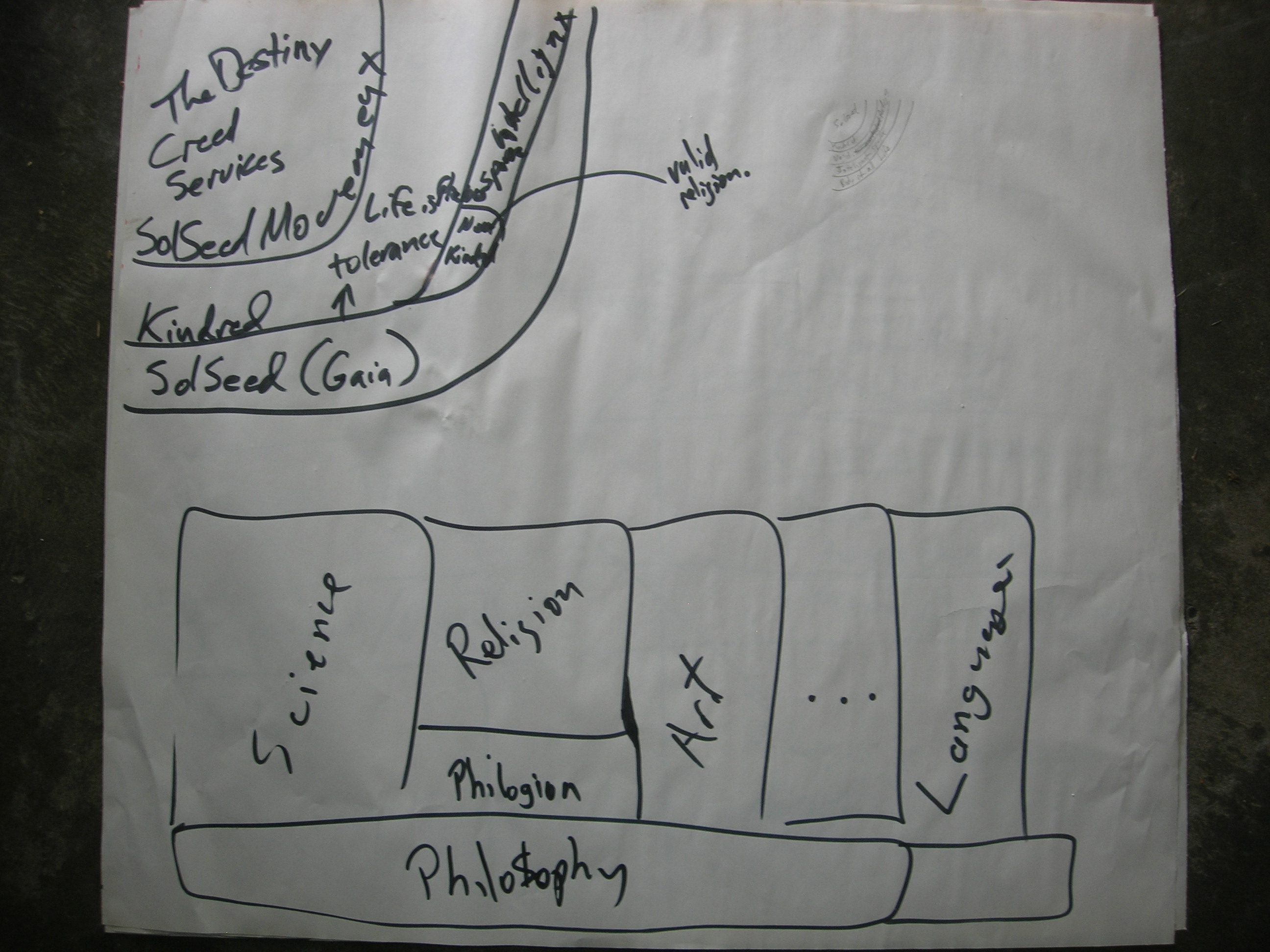
- Paul: There's a quote by David Orr: "the goal of medicine is health, not disease; the goal of economics is abundance, not poverty; you can be very emotionally attached to achieving a vision for the world, but as a scientist you must be objective in your treatment of the data as a tool to get to your vision"
- Eric: Scientists are human beings ... you're not going to bother doing science unless it's part of being a whole human being ... science and religion (or whatever you want to call what we're discussing as "religion") are two out of about a dozen things one can do with one's brain ... don't be Spock all the time, but when faced with data that your instincts tell you should turn out a certain way, you have to be Spock and objectively accept what the data actually says ... what you do with scientific results will involve art, politics, etc ... narrowing yourself to just one field doesn't work ... I do science even though I don't do lab work, I do religion but I've never been to theology school, I do art that I'm proud of although I haven't done art
- Lion: My problem is with the shape of your categories, not your labels
- Ben: Yes, scientists are emotional, and they introduce bias that they shouldn't, and that bias often goes into defending traditional beliefs, meaning the standard current of theory that they are in ... and this is against the principles of science, sure ... but the young scientists are eager to find newer theories ... even though we don't have "true" objectivity, science manages to survive our method of implementing it; it doesn't mean that the method doesn't exist, ... So, when Lion says that there's no something like the scientific method, and Eric says that you have to be Spock when you're doing science, I want to believe something in between
- Brandon: Hank mentioned that religion controls people ... I felt that there was almost universal agreement that that's a bad thing ... what I'm saying very strongly is that religion is a control that creates space in a life of consumption and desire, etc, for something more than that ... religion is the way that the Rider can create a different Elephant ... it's very much about control ... it's a power like dynamite, in that it can be used for good or ill ... that force has often been abused ... Eric's concept of choice could be the antidote to those abuses ... how do you train yourself in the direction you choose, and train your group in the direction your group chooses? how do we channel the power that exists in a direction that creates more of what we yearn for?
- Hank: The Scientific Method is abased by money, ex. Monsanto hiring researchers and paying them only if they produce the results that Monsanto wants ... what modifying force do we have that makes it so the human is interested in sharing, supporting, caring, rather than selfish desire for money and material goods? ... there are (almost) universally agreed-on things that religions tell us not to do, like murder and adultery, so there is a place for religion ... [a bunch of stuff that I missed]
- Lion: I don't need to refer to discipline as religion ... if I want something powerfully, I will start figuring out ways of restructuring my life to pursue it ... I agree with the desire to change things ... when I say "desire," it means "we should do what we want when we want," but only to a degree ... I don't need to define ethics, because I desire ethics ... I think defining things in abstract detail leads us astray
- Paul: Is the Golden Rule a truth? How did that idea come into existence? ... there's a Scientific Method by which we discover truth ... what do we do in this other area, "religion," that makes it grow?
- Eric: The Golden Rule comes from religion trying to discover meaning and purpose ... when I say religion has been done badly, I don't mean there haven't been good fruits of it
- Ben: I don't think ethics like the Golden Rule are meaning
- Paul: The Golden Rule is the Scientific Method, doing an experiment over thousands of years with millions of variables ... the general pattern is that when you follow the Golden Rule, it works out better than when you don't
- Ben: So it's a best practice, not a first principle
- Hank: If we want healthy happy humans, why do we allow people to smoke? ... do we apply a control?
- I took a class with mostly 7th Day Adventists that was about what certain behaviors do to your health, even though most of the audience don't do them in the first place
- My father-in-law died because a truck driver was taking drugs and ran him over ... how to build a society where you don't do things that endanger your fellow man?
- I'm a member of Willamette River Watchers, checking for pollution and jumping on people who are disturbing the ecosystem
- Is it the responsibility of government to post danger signs, or should kayakers do the best they can with the situations they encounter?
- How to avoid having young people who replace outgoing leaders perpetuate the old ways?
Epilogue
- Paul: How do you come to a purpose or meaning or truth that changes your life?
- Lion: I love to have that conversation
- Paul: It's at the heart of a lot of what we're talking about
- Lion: If someone feels that something's off, you can work with them ... ex. if someone's really meek, create an environment where that person can express him/herself
Eric's Thoughts
Gaia's power to create upward spirals can be imagined at every holonic level, ..., cellular, ..., organ, ..., body, ..., community, ..., ecosystem, ..., biosphere, ..., interstellar. What I want to describe is how we can make the link in people's minds between these upward spirals. We need to engage people's imagination so that they can see the invisible power of Gaia blooming through their own bodies and on up through the next levels that they will naturally care about (community and ecosystem) and then on through the biosphere to TheDestiny. We need to draw them a map. In order to do this, we need to make the journey through our own imaginations first.
I admit that not everyone will 'naturally care' about the community or ecosystem levels. As Brandon describes it, many people are immature or broken and so cannot find it in themselves to see all life as precious or in some cases they may not see any life at all as precious. I don't like to see those people as immature or broken because taking that attitude feels like 'using a bulldozer to heal a gully'. It feels like trying to stand in the path of an onrushing torrent at the bottom of a gully. To, instead, begin from a place of openness and understanding and gently guide the most easily moved individuals onto new paths, feels like 'seeing nature and then scratching a diversion'.
My insistence that religion is a choice may have sounded like 'ethical relativism' but I see two ways to go about being ethically relativistic, and the two ways have very different consequences. In one way, you see the choice of ethics as optional and arbitrary and therefore irrelevant; the consequence is that you can do what ever you want; nothing matters. That leads to apathy and cynicism, inaction and the cultural downward spiral that we are currently in. This first way uses ethical relativism as a justification to build no ethical framework at all.
In another way, you see the choice of ethical principals as a search for what works for each individual, community, society and civilization and what speaks to them and has meaning for them; what goals attract them. In this way, ethics becomes more like engineering than science. In engineering there are many possible solutions to any problem. There may or may not be an ideal best solution but generally engineers don't care about the question; the important thing is to find a way that works well enough that the problem is solved with a reasonable amount of effort so that effort is available to solve other problems. Consider computer chips. Maybe there is an ideal computer chip, an ideal way to arrange atoms such that they can create the ultimate computing machine. But the productive engineers have spent no time at all searching for it. Instead they have just improved the chip bit by bit (pun intended ;)) until they have got us to the computers we use today and they will continue improving it until they create the computers we will use next decade and the decade after that. In the end, they may find many different arrangements which are equally good and for which they cannot find a way to improve them. At that point it will be a choice as to which one to build, but most everyone will agree that which ever one we choose it will be better than the Vic20 was.
In this second way of being ethically relativistic we build our ethical frame work and test it and each other community does the same. We recognize that by building many different ethical frameworks rather than just one, our civilization can make more progress toward ethical frameworks that work better in the future. We recognize that there may be no ideal framework but there are probably some that almost everyone can agree are better than the Spanish Inquisition. To join the search for better ethical frameworks, the one requirement is to accept that your current ethical framework may not be the best one possible. Certainly, you must recognize that your ethical framework is not the only one that is valid. In order to be certain that you are not holding back your own progress in ethics you must recognize that no element of your ethical framework is unquestionable. You may be certain to 99% that you have an element right. You may be unwilling to bother spending time questioning that element because it would take away from time spent working on elements of which you are less certain. But avoiding the 100% certainty illusion, you will keep your mind just open enough that if someone puts forward an idea that contradicts your dearest ethical framework element, you will be able to listen. It may not be possible to move you from your choice but by listening you will be able to build a bond with the other person. This bond may appear as an enemy to your own ideas but in the end it may turn out to be an ally. The bond may allow you to access this other person on an emotional level and that access may do more to convince him or her that you are right than any rhetorical argument or arrogant assuredness you throw in the other person's face.
This applies to all elements of religion: seeking spiritual experience, practice, community, giving comfort, finding meaning, working toward goals. Thus ethical relativism becomes religious relativism. This second way of religious relativism will allow us to reach out to everyone more subtly on every level. Our evangelism will entail as much listening as talking. By asserting that 'we believe what we believe' and 'we find meaning in what we do' rather than asserting that 'everyone should believe what we believe and do what we do', we will allow others to see our ideas and ideals without feeling we are forcing our conceptual framework upon them. This will make them more open to our ideas and ideals. In the end, our own ideas will make more progress by our listening than by our opposing.
One of the things that puzzled people at the conference was that I insisted that the necessity was openness rather than reverence for life. I was never able to express clearly why I felt this was so. I think this was because I was unable to express what I saw as the consequences of not being open. I heard phrases like, 'Are we supposed to condemn those who are not open, isn't that not being open.' I didn't want to condemn anyone. The consequence of not being open is that you cannot 'join in the search'. It is not a consequence we impose, it is a consequence that those who fail to be open impose on themselves. I want to assert that openness is an essential part of the religious method because it is the doorway through which the method becomes available to its potential users. I want to assert that we must remain open to ideas that oppose our most fundamental beliefs because I do not want to be excluded from the search for better ways. This is why I oppose including 'life is precious' in the religious method just as I would oppose the inclusion of 'the universe is older than 10000 years' in the scientific method. 'Life is precious' is a choice that we made by using the religious method just as the age of the universe is a truth discovered by the scientific method. Neither is part of the method itself. My certainty that 'life is precious' is a necessary part of the best choice is on the order of (100% - 1/infinity) but it is not 100% and so I can listen to other views and still be part of the search. By asserting that in using the religious method, our first step is accepting uncertainty about our own practices and beliefs, we are not judging anyone, we are showing others how the door can be opened for them into the search for better ways.
Once they accept that first principle they will listen with more open minds to our beliefs and will take them on if our beliefs speak to them. For that to happen our next step is to articulate our beliefs in ways that are most likely to speak to others. This is where mapping comes in. We need to map the relationship between the upward spirals and map how contributing to the lower level spirals and then ever higher level spirals leads to our beautiful vision of Sol's family of new worlds.